
Cumberland County Court Records After Arrest
After a Cumberland County jail arrest, the first public record may be the booking entry on the jail roster. That entry is not the final court record. The arresting agency can list charges, an OTN, a case number, a court date, and a bond field in the jail system, but the Cumberland County State's Attorney decides what formal charges to file. Once filed, the case is maintained in Cumberland County Circuit Court by the Circuit Clerk.
The local court path involves three offices. Cumberland County Jail and the Sheriff's Office hold booking and custody records. Circuit Clerk Rhonda Wilson's office maintains filed court cases, docket entries, payments, certified dispositions, and older files. State's Attorney Bryan Robbins is the prosecutor whose office reviews police reports and files, amends, dismisses, or pursues charges. Court users should not treat roster charge text as a conviction or as a certified court disposition.
For custody or booking details, use Cumberland County jail inmate records. For booking-photo access, use the Cumberland County jail mugshots page. For court records after a jail arrest, the key issue is what charge the prosecutor filed and how the court case changed after first appearance.
Find Court Records After Jail Arrest
The official court directory and Fifth Judicial Circuit both route Cumberland County users to Judici Cumberland County Case Search for online case access. During research, direct inspection of Judici showed a human-verification page and a disclaimer that Judici is operated by Judici.com, not by the court. That means online access may require captcha steps and may not expose every document, image, or certified copy.
- Start with the BlueHorse roster if the arrest is recent, and note the name, booking date, arrest agency, case number, OTN, and court date if shown.
- Open Judici Cumberland County Case Search through the court link and search with the best case information available.
- If Judici is blocked, incomplete, or missing the document, contact the Circuit Clerk for the official court file.
- For a certified disposition, use the Circuit Clerk, not the jail roster or a screenshot of the online docket.
- For charging-office questions, contact the State's Attorney, but do not ask that office for defense legal advice.
The Judici case-search screenshot captured for this build documents the access limitation instead of inventing search fields that were not visible during inspection.
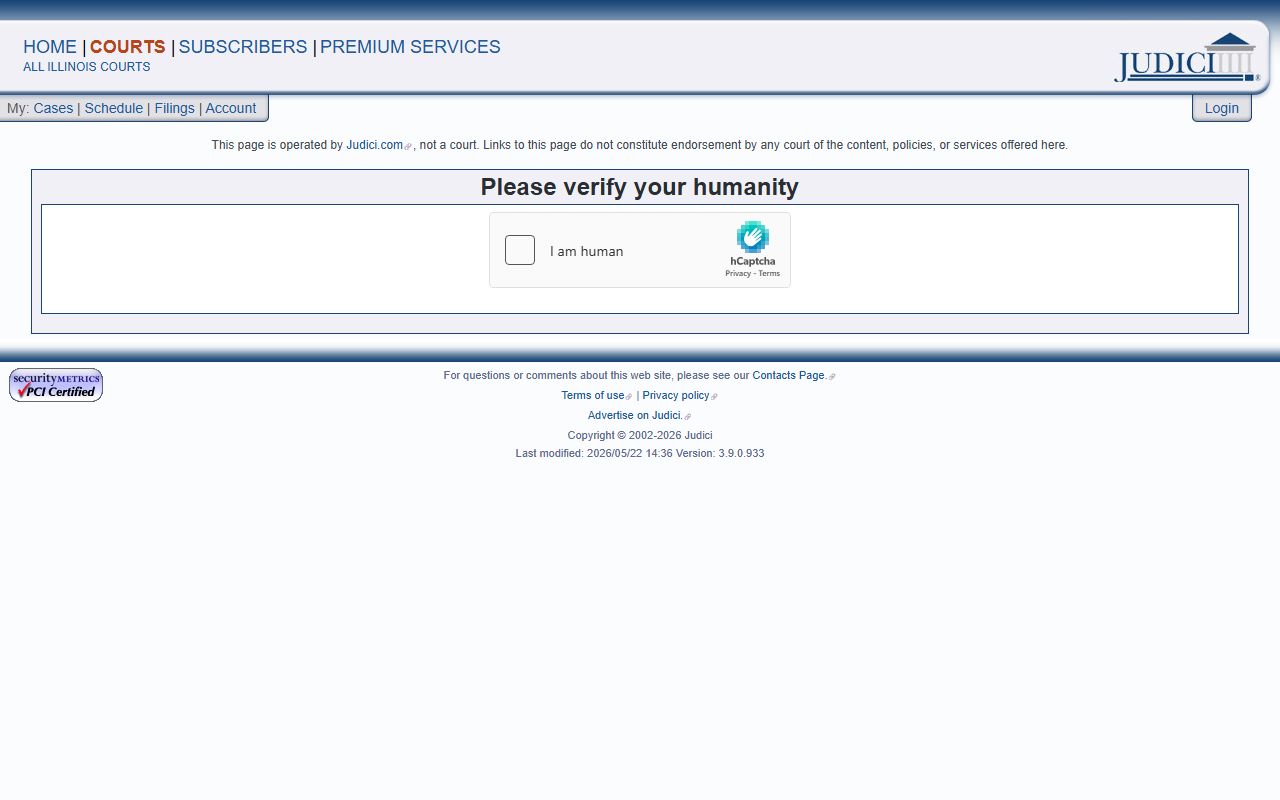
When an online court portal blocks access or omits a file, the clerk's office remains the official records route for Cumberland County court records after an arrest.
Cumberland County Court Records Contacts
Cumberland County court records after a jail arrest are handled at the courthouse in Toledo. The Illinois Courts directory lists the Cumberland County Courthouse at 1 Courthouse Square, court hours of 8:00 a.m. to 4:00 p.m., free parking around the square, Mass Ride Transit, and an e-filing kiosk in the Circuit Clerk's office on the first floor. The Fifth Judicial Circuit Cumberland County page adds the presiding judge, court administration, Circuit Clerk, State's Attorney, and probation contacts.
Circuit Clerk
Rhonda Wilson
PO Box 145, Toledo, IL 62468
(217) 849-3601
Mon-Fri, 8 a.m. to 4 p.m.
State's Attorney
Bryan Robbins
PO Box 387, Toledo, IL 62468
(217) 849-2311
Charging and prosecution office
Charging Documents After Arrest
The court record starts with a filed charge, not just the fact that a person was booked into Cumberland County Jail. The prosecutor may file the same charge listed in the roster, amend the charge, add a charge, reduce a charge, or decline to file. Three terms appear often in Illinois criminal records, and each describes a different way a charge can reach the court file.
| Document | Who Uses It | What It Means |
|---|---|---|
| Complaint | Officer or prosecutor | An initial charging document, often used in misdemeanor or preliminary felony contexts. |
| Information | State's Attorney | A formal prosecutor-filed charge used in many felony and misdemeanor cases. |
| Indictment | Grand jury | A grand-jury charging document, often tied to more serious felony matters. |
The court file is the place to verify the actual filed document. A jail roster charge can be a useful clue, especially if it shows a case number or OTN, but the Circuit Clerk's file controls the official case record.
Cumberland County Charge Status
Court records after a jail arrest change over time. A charge can start as pending, then be amended, reduced, dismissed, or resolved by plea, trial, supervision, or another court order. A booking profile can show a roster disposition field, but that field is not the same as the final court disposition.
| Status | Plain Meaning | Where to Verify |
|---|---|---|
| Pending | The case or charge has not reached a final outcome. | Judici or Circuit Clerk. |
| Amended or reduced | The prosecutor or court changed the charge from an earlier version. | Court docket and filed documents. |
| Dismissed | The charge was not carried forward to conviction in that case. | Certified disposition from the clerk. |
| Nolle prosequi | The prosecutor chose not to pursue the charge. | Court docket and clerk record. |
| Conviction | A formal guilty finding or plea accepted by the court. | Certified court disposition. |
Bond and Pretrial Release Records
The sheriff FAQ says bond can be posted 24 hours a day, 7 days a week at the Cumberland County Sheriff's Office. It also recommends direct posting at the Sheriff's Office instead of depositing commissary funds for bond. The reason is practical: commissary money becomes the inmate's property, may be used at the inmate's discretion, is not returned to the depositor, and can be reduced by negative balances before the inmate tries to use it for bond.
Illinois pretrial law has changed, so current cases should not be framed as commercial bail-bondsman cases. 725 ILCS 5/110-7.5 addresses previously deposited bail security and related petitions, while current release or detention depends on court orders and pretrial findings. A roster bond field may still show a bond type, amount, or status because records can include older orders, court-specific entries, or local release conditions.
Release warning: A detainer, warrant, federal hold, ICE hold, or IDOC parole hold can prevent release even when a local bond field appears payable.
Warrants Before a Cumberland Arrest
No official Cumberland County active warrant list or public warrant search was located on sheriff or county pages. If a warrant leads to arrest, the person may appear in the jail roster after booking if the record is public. Judici may show bench-warrant activity or case events when the public docket is accessible, but the safest local contacts are the sheriff for warrant-status process and the Circuit Clerk for court case context.
- Arrest warrant
- A court order authorizing law enforcement to arrest a person in a criminal matter.
- Bench warrant
- A judge-issued warrant, often after failure to appear or violation of a court order.
- Detainer
- A hold or request from another agency that can keep a person in custody after local issues are addressed.
- Federal warrant
- A federal court or U.S. Marshals matter, not a county-only roster issue.
Charges vs Convictions
A charge after arrest is an accusation. A conviction is a court outcome. This distinction matters for Cumberland County court records because a jail booking, charge table, or first-appearance date can be public even when the final case is later amended, dismissed, or resolved without a conviction. The final answer comes from the court disposition.
| Question | Charge | Conviction |
|---|---|---|
| What is it? | An allegation filed or listed after arrest. | A formal guilty finding, plea, or adjudication. |
| Where appears first? | Roster charge table or court filing. | Court disposition. |
| Can it change? | Yes, it may be amended, reduced, or dismissed. | Changes only through court process or later relief. |
| Best proof | Filed charging document. | Certified disposition from the Circuit Clerk. |
Sealed vs Expunged Records
Some court records after an arrest may be unavailable to the public because of sealing, expungement, juvenile confidentiality, victim-protection rules, active investigation limits, or other legal restrictions. Illinois FOIA, 5 ILCS 140, supports access to non-exempt public records, but it also works alongside exemptions and confidentiality laws. A court order is the strongest route for correcting or limiting official criminal case visibility.
| Record Treatment | Public Effect | Practical Route |
|---|---|---|
| Sealed | Hidden from most public access but not erased for all purposes. | Verify the seal with the Circuit Clerk and provide orders to record custodians. |
| Expunged | Removed or treated as cleared under the applicable court order. | Use the court order with the clerk, sheriff, and other custodians as needed. |
| Juvenile or confidential | Generally restricted from routine public display. | Ask the clerk which records, if any, are releasable. |
Cumberland County Records Requests
The county FOIA officer PDF says public-record requests must be in writing and may be emailed. Jail booking records belong with the sheriff. Court files and certified dispositions belong with the Circuit Clerk. Prosecutor records belong with the State's Attorney. A useful request names the person, date of arrest or booking, case number or OTN if known, requested document type, preferred email delivery, fee limit, and requester contact information.
For court payments, the Circuit Clerk page notes mail payments by money order, cashier's check, or personal check, online payment through Judici, and phone payment through Court Money. Payment details do not replace a court-record request, but they are often linked to the same case number, ticket number, or birth date used to identify a file.